Professional Commercial Roofing Services in Orlando
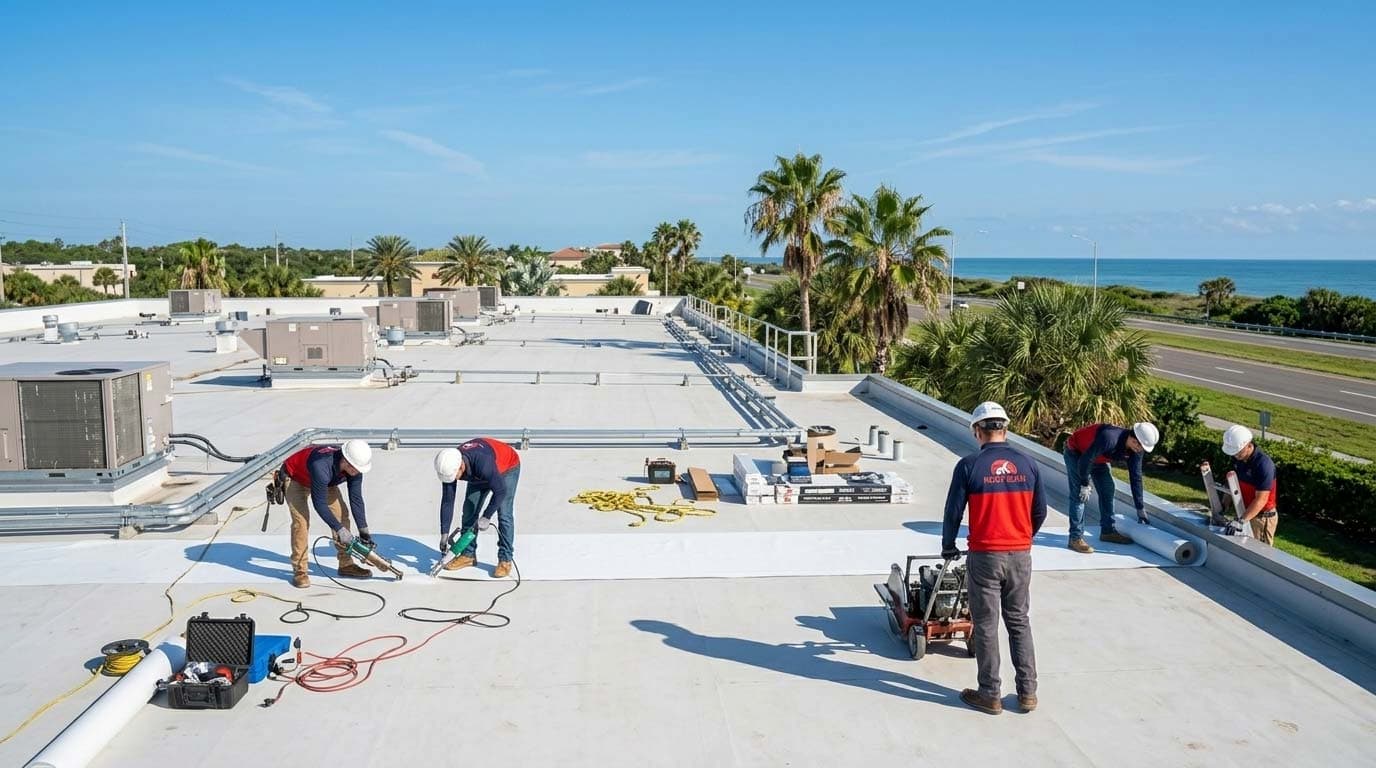
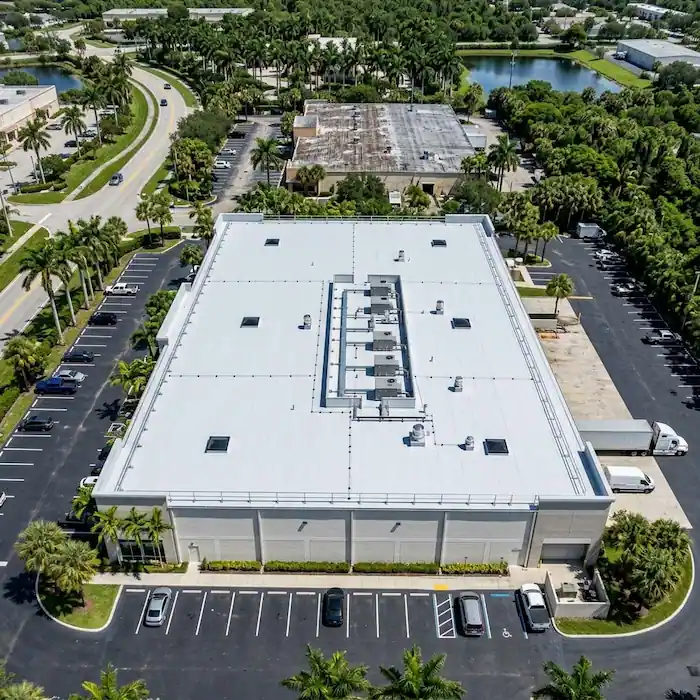
Roof Bear provides licensed commercial roofing services for Orlando properties: TPO, EPDM, modified bitumen, and standing seam metal installation, restoration, and repair. We serve multi-family complexes, retail centers, office buildings, warehouses, and manufacturing facilities across Orange, Seminole, and Osceola counties with in-house crews and Florida Building Code compliance on every project.

Reliable Commercial Roofing Solutions for Orlando Businesses
Licensed Commercial Roofing Credentials
- Florida license CCC1334010 held by Tyler Nerland
- GAF Master Elite® and President's Award Contractor (top 1% nationally)
- GAF Commercial Certified and GAF Solar Certified
- Owens Corning Preferred Contractor
- 4.8 stars across 200+ Google reviews
- Over 7,000 roof installations completed in Florida since 2020
- All in-house employees with no subcontractors

Managing Partner · Technical Oversight Lead · Veteran
Hector has developed one of central Florida's top commercial roofing crews - and he himself is personally named in dozens of customer reviews for his transparency, craftsmanship, and above-and-beyond service.
Reviewed by Hector Marin. License Number CCC1334010 held by Tyler Nerland · Verified by Florida DBPR
Why Commercial Roofing Failures Escalate Fast in Central Florida
Commercial roofs fail in predictable patterns. Single-ply membranes develop seam separations where thermal cycling pulls bonded edges apart. Metal panel systems leak at penetrations and ridge caps when fastener holes enlarge under wind uplift. Modified bitumen surfaces crack when UV degradation hardens the asphalt layer, then water enters the roof deck and insulation below. Once moisture infiltrates, damage compounds: wet insulation loses R-value and adds structural load, interior finishes stain and mold, and business operations face disruption.
Florida's regulatory landscape adds a critical dimension. The Florida Building Code 25 percent rule determines project scope: if your existing roof was built or last replaced under the 2007 code or later, and repairs affect 25 percent or more of that roof section, only the repaired portion must meet current code standards. For older roofs predating March 1, 2009, exceeding that 25 percent threshold triggers a full roof replacement to bring the entire assembly into compliance, converting what appeared to be a patch job into a permitted capital project with engineering, inspections, and extended downtime.
Orlando roofing contractor selection carries direct liability exposure. Hiring an unlicensed operator or a residential-only contractor voids manufacturer warranties, exposes the property owner to stop-work orders and permitting violations, and leaves no workers' compensation or liability insurance coverage when job-site injuries or property damage occur. Before signing a commercial roofing contract, verify the contractor's CCC license status through the Florida Department of Business and Professional Regulation database, confirm active general liability and workers' compensation policies, and request certificate of insurance naming your entity as additional insured.
Site Assessment and Documentation
We begin with a physical roof inspection using thermal imaging to locate moisture intrusion, core samples to verify existing insulation and deck condition, and pull tests on membrane adhesion or fastener withdrawal resistance. Our crews document all penetrations, drainage pathways, expansion joints, and parapet conditions. We identify code compliance gaps, structural load capacity, and fire rating requirements. The written report includes photos, identified deficiencies, repair or replacement recommendations, and a cost estimate, delivered within 24 hours. Inspections paired with a repair or replacement quote are provided at no charge.
Engineering and Permitting
For projects triggering the 25 percent threshold or new installations, we coordinate structural engineering calculations for wind uplift resistance per ASCE 7 and Florida Building Code High Velocity Hurricane Zone requirements. We prepare permit applications with sealed drawings, product data sheets showing Miami-Dade NOA approvals where applicable, and fastening schedules. In Orange County, Osceola County, and Seminole County jurisdictions, we manage plan review, respond to comments, and schedule inspections at deck, insulation, and final membrane stages.
Roof System Selection and Specification
We install TPO roofing in 60-mil and 80-mil thicknesses, mechanically fastened or fully adhered depending on substrate and wind exposure. EPDM roofing goes down as ballasted, adhered, or mechanically attached systems, with seams hot-air welded or tape-bonded per manufacturer specifications. Modified bitumen membranes are torch-applied or cold-adhered in two-ply configurations over polyiso or fiberglass insulation. Standing seam metal roof systems use Galvalume or aluminum panels with concealed clip fastening, thermal breaks at purlins, and butyl sealant at all laps and transitions. Each system is specified to meet or exceed the required fire rating, wind uplift class, and energy code thermal performance for the building type and occupancy.
Tear-Off and Deck Preparation
On replacement projects, we remove existing membrane, insulation, and base sheet to expose the roof deck. Crews inspect for damaged decking, rust perforation on metal decks, or delaminated plywood, and replace compromised sections. We verify deck fastening meets current uplift load tables and add screws or structural adhesive where needed. Horizontal surfaces are swept clean, and all debris is contained in dump trailers staged on-site to maintain OSHA compliance and prevent job-site litter violations.
Insulation and Drainage Integration
We install rigid insulation in tapered layouts to achieve positive drainage toward scuppers and drains, with a minimum quarter-inch per foot slope. Polyiso insulation boards are mechanically fastened or adhered with compatible adhesive, with staggered joints and cut edges sealed to prevent thermal bridging. Crickets are built at HVAC curbs and parapet transitions to eliminate ponding water. All penetrations receive prefabricated pitch pans or custom-fabricated sheet metal boots integrated into the insulation layer before membrane installation.
Membrane Installation and Seam Integrity
TPO and EPDM membranes are rolled out in the longest practical lengths to minimize seams, with overlap widths per manufacturer detail. Hot-air welding of thermoplastic seams is performed at temperatures verified by infrared thermometer, with probe testing of sample seams each morning and at every membrane splice. Mechanically fastened systems use fastener plates spaced per the engineered wind uplift schedule, with membrane pulled tight to prevent billowing. Flashing at walls, curbs, and edges is embedded in mastic and mechanically fastened with termination bars, never caulk-sealed. Modified bitumen seams are torched to achieve full interply adhesion with a consistent bleed-out line visible along the lap.
Penetration Flashing and Parapet Detailing
Pipe boots, electrical conduit, and mechanical supports are flashed with prefabricated EPDM or TPO accessories heat-welded or mastic-sealed into the field membrane. HVAC curbs and equipment supports receive custom-fabricated metal counterflashing lapped over membrane base flashing, with fasteners sealed with butyl tape. Parapet caps are fabricated from 24-gauge Galvalume or aluminum, lapped at inside and outside corners, and mechanically fastened through cleats to prevent fastener exposure. All vertical terminations extend a minimum eight inches above the finished roof surface and are sealed with compatible caulk after mechanical attachment.
Quality Control and Final Inspection
We flood-test all drains and scuppers, probe-test all heat-welded seams, and perform a final walk to verify fastener patterns, flashing laps, and membrane tension. Our project manager photographs completed details for warranty documentation and reviews the checklist with the building inspector at final inspection. We provide the property owner with a complete warranty package including manufacturer material warranty, our workmanship guarantee, and as-built drawings showing all penetrations, drains, and membrane layout for future maintenance reference.

Florida Building Code and Commercial Roofing Compliance
The Florida Building Code, 8th Edition (2023), took effect December 31, 2023, establishing current standards for roof assembly fire resistance, wind uplift classification, and impact resistance in High Velocity Hurricane Zones. Commercial roofing contractors in Florida operate under a regulatory framework that requires both technical competency and financial accountability: state licensure mandates passage of a business and finance exam plus a roofing trade exam, proof of four years of experience, and maintenance of general liability insurance and workers' compensation coverage. Florida employs over 25,000 roofers, and demand is expected to grow faster than the national average over the next decade, yet fewer than 2 percent of roofing contractors in North America hold GAF Master Elite certification, which requires demonstrated installation quality, consumer satisfaction, and business stability verified through annual audits.
For commercial property owners in Orlando, these regulatory distinctions determine not only whether the roof meets code but whether the installation is legally defensible. The cost of maintaining a Florida certified roofing contractor license includes continuing education at $50 to $200 per course, general liability insurance starting at $1,000 per year, and surety bonds ranging from $200 to $600, according to industry compliance guidance. These ongoing expenses filter the market: contractors who maintain active licensure and insurance demonstrate both technical commitment and financial solvency.
What Commercial Property Managers Say
Joe Garcia wrote:
"Roof Bear replaced the roof on my rental property and did an exceptional job. The crew was professional, efficient, and left the site spotless each day. Tyler and his team were transparent throughout the process, and the final result exceeded my expectations. Highly recommend for any roofing needs."
Danielle Shaw noted:
"From start to finish, the Roof Bear team was outstanding. They replaced our roof quickly and professionally, handling every detail with care. The communication was excellent, and they ensured we understood each step of the process. Our new roof looks fantastic, and we couldn't be happier with the results."
Taylor Gonzalez shared:
"Roof Bear provided top-notch service for our roof replacement. The team was punctual, courteous, and meticulous in their work. They addressed all our concerns and made sure we were completely satisfied. The quality of their work is evident, and we highly recommend them."
Commercial Roofing Service Area in Central Florida
We provide licensed commercial roofing services throughout Orlando, Winter Park, Altamonte Springs, Lake Mary, Sanford, Apopka, Oviedo, Winter Garden, and Kissimmee. Our service area covers Orange County, Seminole County, and Osceola County, including multi-family properties, retail centers, office buildings, warehouses, healthcare facilities, educational facilities, and industrial roofing projects across Central Florida.

Get a FREE Quote Today!
Our team of friendly experts can assess the needs of your home and provide you with the knowledge you need to make informed decisions.

Award-Winning Florida Roofing Company




Frequently Asked Questions About Commercial Roofing in Orlando
What is the 25% roof rule in Florida?
Florida Statutes 553.844(5) establishes that if an existing roof section was built, repaired, or replaced under the 2007 Florida Building Code or later, and 25 percent or more of that section is being repaired, replaced, or recovered, only the affected portion must meet current code standards.
How much is it to replace a commercial roof?
Commercial roof replacement costs vary by system type, building size, and existing conditions. Single-ply TPO or EPDM systems typically cost less per square foot than modified bitumen or standing seam metal. For residential-scale multi-family buildings, standing seam metal costs between $14,000 and $25,000 for a 1,500 square foot roof, while architectural shingles on similar square footage range from approximately $7,500 to $12,000. Larger commercial structures require site-specific estimation accounting for roof access, insulation requirements, drainage modifications, and permit fees. We provide written estimates with material specifications and scope of work within 24 hours of inspection.
What is the 25% rule for roofing?
The 25 percent rule determines whether a repair project can proceed under existing code or must meet current standards. For roofs built under Florida Building Code 2007 or later editions, repairing 25 percent or more of a roof section triggers compliance only for that repaired section. For older roofs, crossing the 25 percent threshold mandates full roof replacement to current code, including wind uplift classification, fire rating, insulation thermal performance, and drainage slope requirements. The rule applies to roof area, not cost: repairing 30 percent of a roof's square footage activates the threshold even if materials account for a smaller percentage of total replacement cost.
What commercial roofing companies are available in Orlando, Florida?
Orlando supports multiple commercial roofing contractors, but licensure and certification differentiate qualified firms. Roof Bear holds Florida license CCC1334010, GAF Commercial Certification, and Master Elite status earned by fewer than 2 percent of North American roofing contractors. We maintain in-house crews with no subcontractors, verified general liability and workers' compensation insurance, and manufacturer certifications for TPO, EPDM, modified bitumen, and standing seam metal systems. Before selecting a commercial roofing contractor, verify active state licensure through the Florida Department of Business and Professional Regulation, request current certificates of insurance, and confirm manufacturer warranty eligibility through the contractor's certified installer status.
Schedule Your Orlando Commercial Roof Assessment
Roof Bear provides licensed commercial roofing services across Orlando and Central Florida with in-house crews, Florida Building Code compliance, and manufacturer-backed material warranties. Call (407) 594-7302 to arrange a free site inspection, thermal imaging assessment, and written estimate delivered within 24 hours. We serve multi-family properties, retail centers, office buildings, warehouses, and industrial facilities throughout Orange County, Seminole County, and Osceola County.
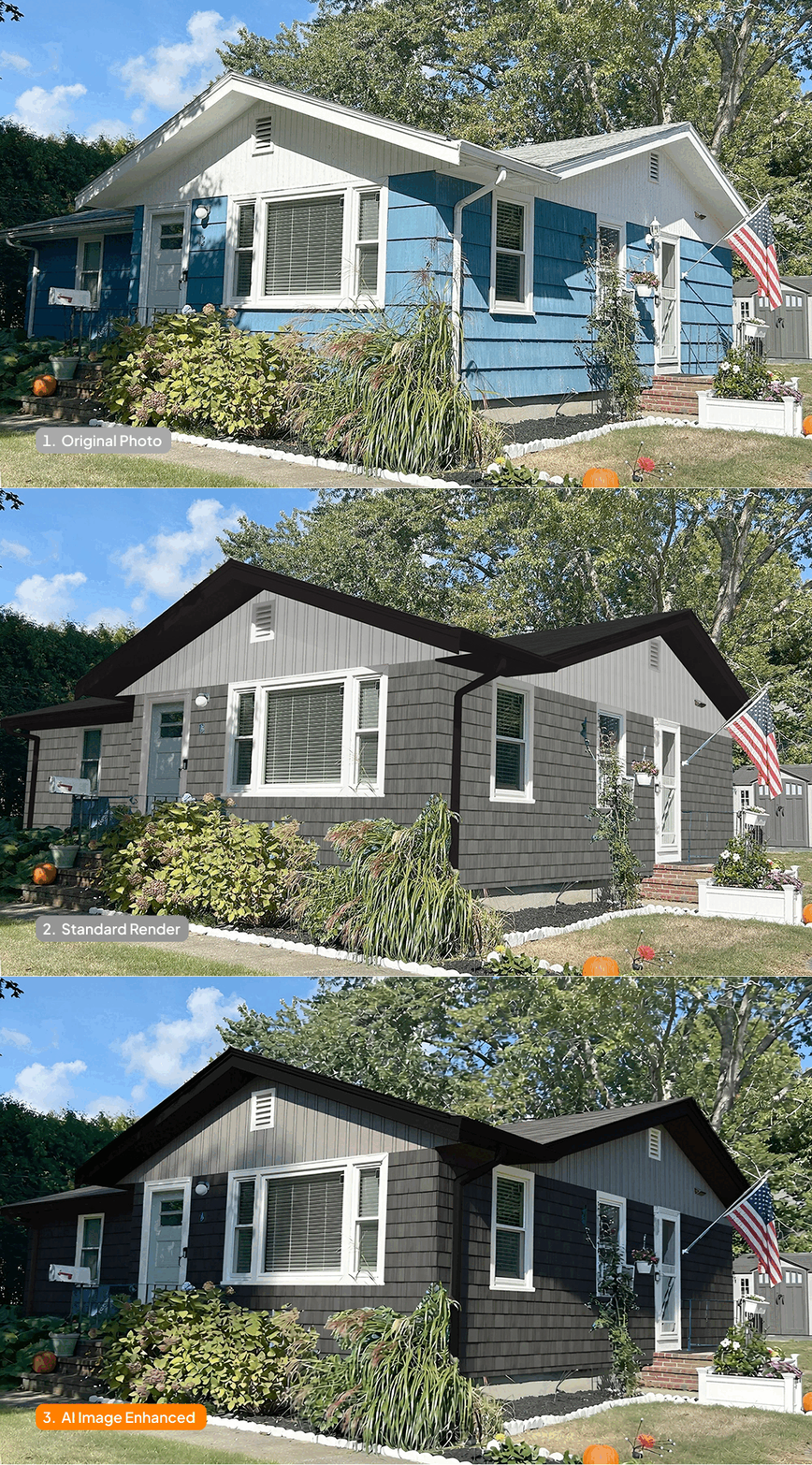
Visualize Your New Roof!
See exactly what your new roof will look like with our free visualization tool.